
Attendance after hours: $80–$180
The figure that gets a licensed plumber to your door at night. Quotable on the phone, every time.
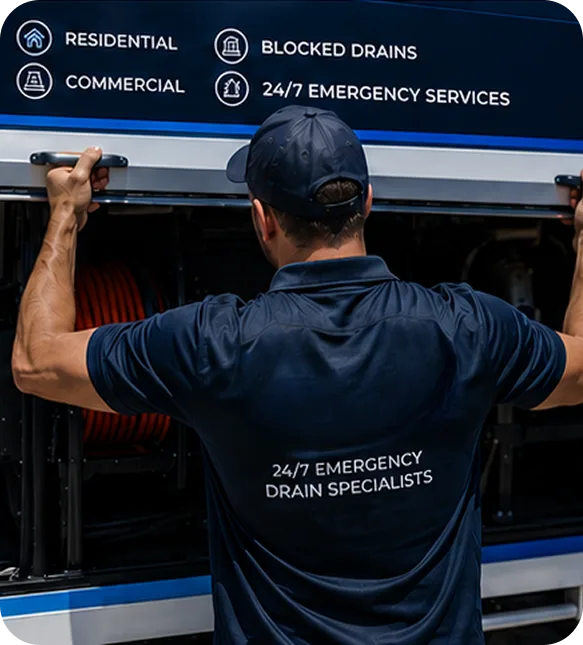
A burst pipe at 2am does not wait for business hours, and neither do we. One call reaches a licensed plumber rather than an answering service, and a crew is dispatched to Newington with the gear to stop the problem rather than look at it.
The honest test is whether it is still getting worse while you wait. Water, waste or gas going somewhere it should not, and not stopping. A burst pipe, sewage backing up into the shower, a hot water tank emptying through the ceiling, or any smell of gas: those are emergencies, and waiting until morning multiplies the damage bill.
Then there is the category people apologise for calling about: the only toilet in the house blocked, no hot water with a newborn, a drain backing up the night before an inspection. Call anyway. An after-hours call here reaches a plumber, not a promise of one tomorrow.

The single most common emergency in a new estate is not a plumbing failure at all — it is building material that went into the line during construction and has been gradually collecting waste around it ever since.
Newington sits on the Parramatta River peninsula in Sydney’s west (postcode 2127), a master-planned suburb built as the 2000 Olympic athletes’ village and bordered by Sydney Olympic Park, Silverwater and the Millennium Parklands. Its compact townhouses and shared drainage lines bring their own set of blockage problems.
Sand, mortar, grout and offcuts do not flush. They settle at the first low point and narrow the line until an ordinary night's use finally closes it. One proper clear usually ends it permanently, which is why it is worth doing thoroughly the first time.
The slowest part of an apartment emergency is often not the plumbing — it is the door. Fob access, a basement that needs a resident to open it, a car park with no after-hours entry: any of those can add half an hour while water is still running.
Townhouse rows share boundary sewer lines, so one household’s blockage quickly becomes the whole row’s problem, backing up the lowest gully first.
Two things worth doing before you ever need them: find your lot's isolation valve — usually in the laundry or a hallway cupboard — and save the building manager's after-hours number in your phone. Both take five minutes on a calm evening and both save real time on a bad one.
Two separate systems run under most properties around Newington: stormwater, which takes rain from roofs and yards, and sewer, which takes everything from inside the house. They are not supposed to meet.
Low-lying land beside Haslams Creek and the river gives Newington’s stormwater pipes little fall, so silt and leaf litter from the parklands settle and slowly choke them.
When they do — an illegal connection, a cracked line, a surcharging pit finding its way into the wrong pipe — heavy rain overwhelms a system never built for it, and the symptoms appear indoors. Working out which system has actually failed is the first thing we do, because the repair, the cost and who is responsible all follow from it.
A yard that floods in every serious downpour is a different problem from one that flooded once in a freak storm. The first is a blocked or undersized line and it will keep happening; the second is weather.
Telling them apart takes a camera on a dry day, not a guess in the rain. If it has happened twice, book the inspection between storms — clearing a surcharging pit at the height of it costs more and tells you less.
On a newer home this question is worth asking before anyone starts work, because the answer can be worth thousands. Defects in workmanship are typically covered for a period after completion; blockages from ordinary use are not.
What settles it is evidence. We record what the camera shows and describe the fault in terms a builder or insurer can act on — a displaced joint, a fall out of tolerance, debris from construction. You may still choose to have us fix it tonight; the documentation is what lets you recover the cost afterwards.
In a block, a single blockage low in the stack shows itself in whichever apartment sits lowest — which is frequently not the apartment that caused it. If your ground-floor shower is backing up when the neighbours run water, the line is telling you the problem is downstream of all of you.
That is worth knowing before anybody starts apportioning blame or cost. A camera up the stack settles it in twenty minutes, and the footage is what the strata manager needs to act on rather than a description of what somebody saw.
The figure that gets a licensed plumber to your door at night. Quotable on the phone, every time.
Business hours run about $120–$160. The premium is real and every genuine after-hours outfit charges one.
Attendance plus the first stretch of work plus minor parts. An isolated burst, a blocked toilet, a failed valve.
Slab leaks, gas faults, anything structural at 2am. Quoted before it starts, in writing.
The cheapest outcome, and one we give often. Describe it honestly and we will tell you which side of the line it is on.
Indicative Sydney ranges for 2026. Your job gets a fixed figure before anything begins. Figures here are indicative of the 2026 Sydney market rather than a quote from us, you get your own number as a fixed price before any work starts.

Not a call centre. You describe what is happening, we tell you what to shut off right now, and whether this genuinely needs someone tonight. Sometimes it does not, and we say so.
The nearest available crew heads for Newington with the common failure points already stocked on the van: pipe, fittings, valves, drain gear.
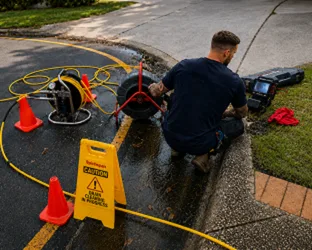
First job on site is stopping the damage: isolate, contain, make safe. Then you get a fixed price for the proper repair before it starts.

Most emergencies are permanently repaired on the spot. If a part has to wait for a supplier, you are left safe, watertight and functioning in the meantime.
Leave your details and an on-call plumber rings back. You will get instructions on what to isolate before anything else.
Phone is quickest at night. The form works too and reaches the crew covering Newington rather than a national call centre.

Leave your details and our local Newington team will call you back fast.